
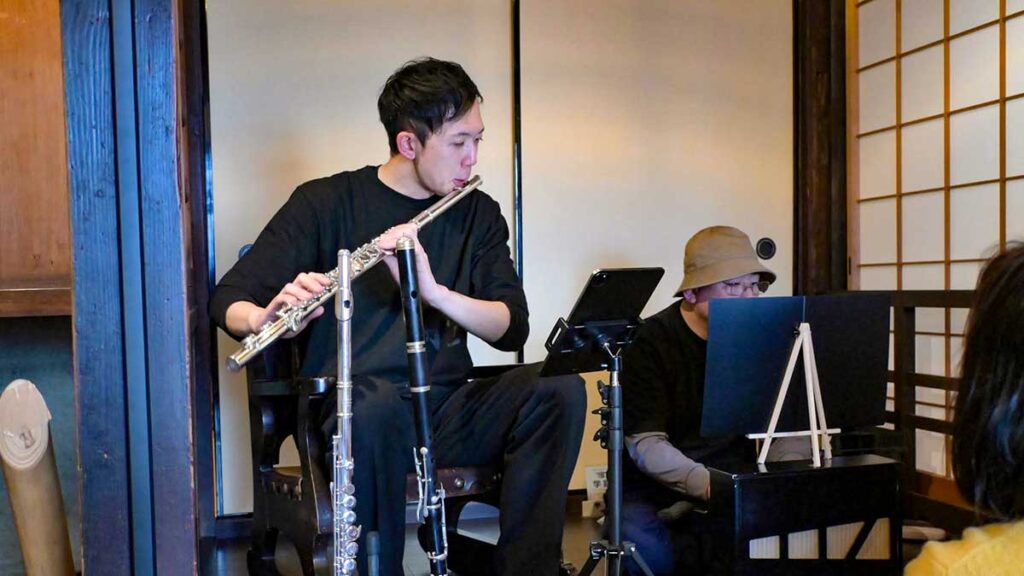
In January 2026, the gallery “Nikai,” located in the Hanare district of Kyoto, hosted Oumei no Gogo (“An Afternoon of Resonant Calls”). The event brought together a live performance by the musical duo Yuukai(Mokuzou)Kenchiku and an exhibition of works by lacquer artist Nagisa Nukina. Over the course of two days, the space was transformed into an immersive environment in which sight and sound seemed to dissolve into one another.
Surrounded by an atmosphere unlike any previously experienced in the gallery, visitors sensed new possibilities within the intimate setting of “Nikai.” We spoke with the two members of Yuukai(Mokuzou)Kenchiku, the organizers of the event, about the ideas and processes that shaped this remarkable collaboration.
Please introduce Yuukai(Mokuzou)Kenchiku.
The project originates from an instrumental band called Yuukai Kenchiku (“Molten Architecture”). The five-member ensemble—flute, electric guitar, keyboard, bass, and drums—describes its style as “multidimensional rock.” Drawing inspiration from music across eras and regions, the group seeks to forge a distinctive sound that transcends conventional genre boundaries.
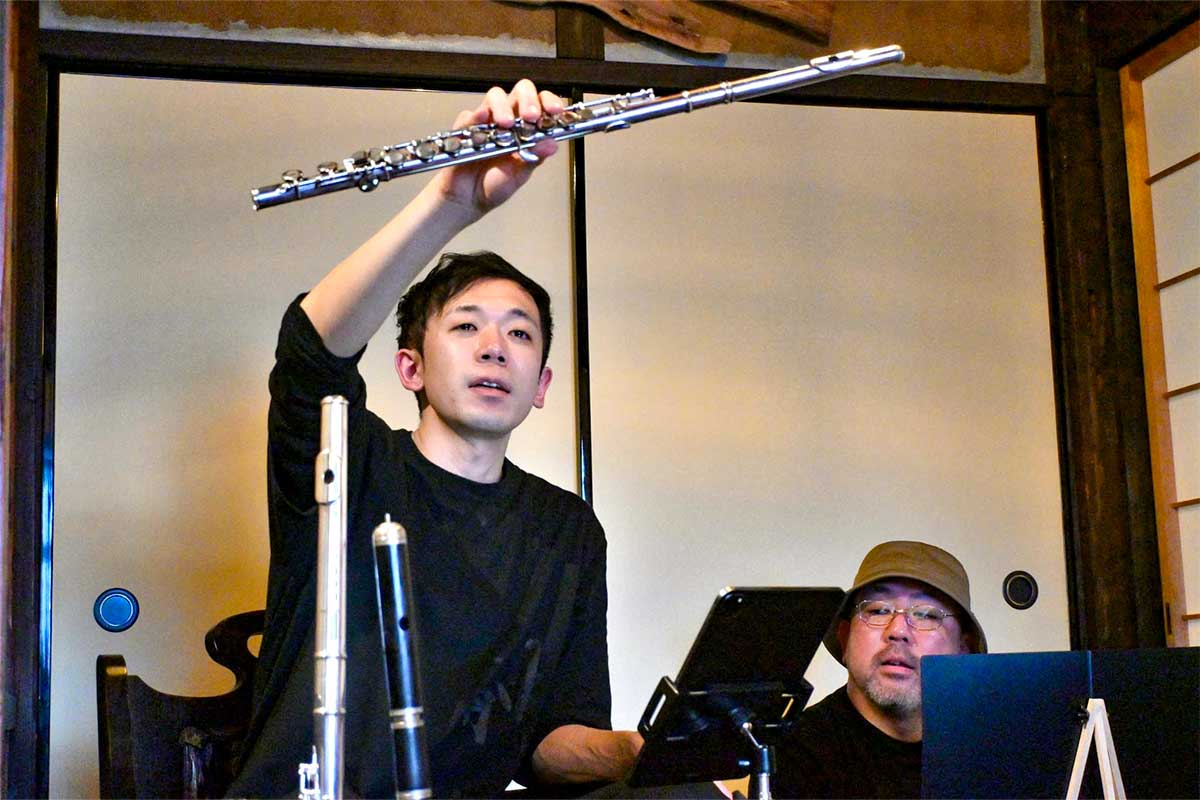
Yuukai(Mokuzou)Kenchiku is a sub-unit that reconstructs the band’s compositions as a duet for flute and piano. With fewer instruments, the structural essence of each piece becomes more apparent, and the overall impression shifts dramatically. Rather than rock-oriented, the music often takes on a character closer to chamber or classical music. This reduced format also allows the use of baroque and romantic flutes—wooden instruments whose subtle tonal variations might otherwise be overpowered in a full band setting—thereby revealing delicate nuances of timbre and expression.
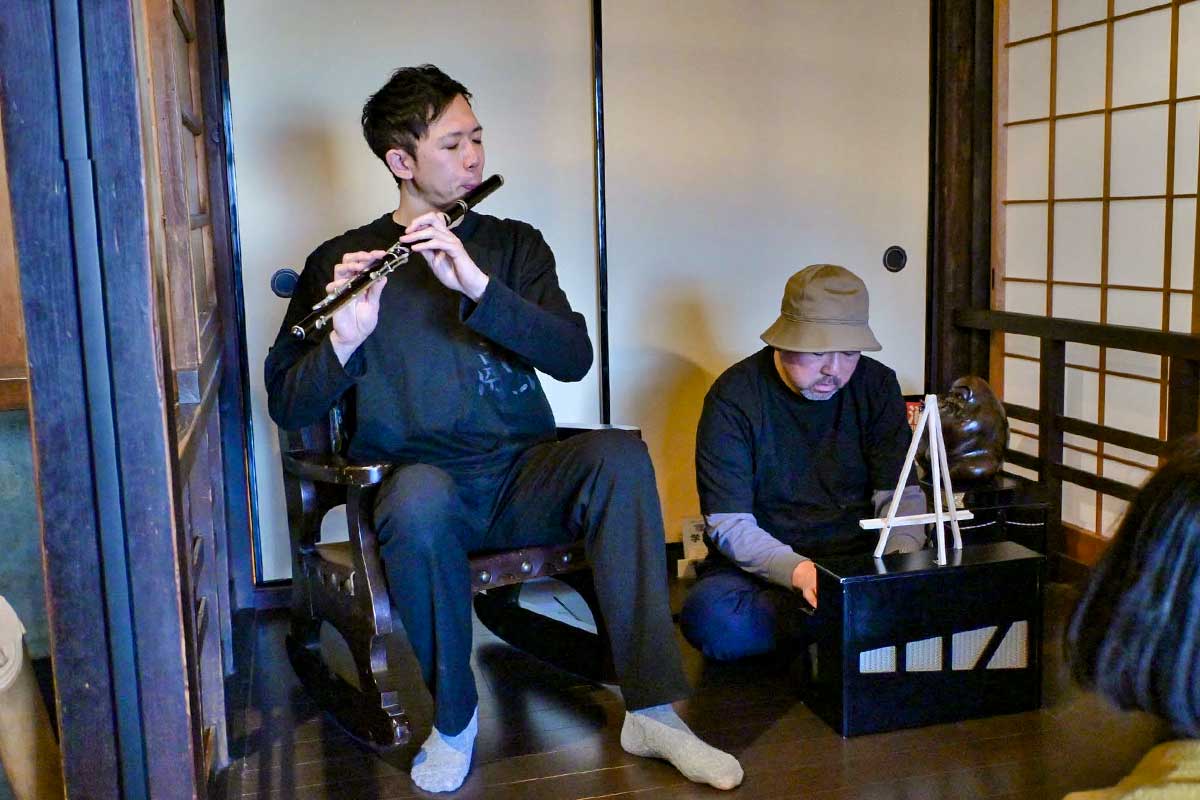
For this event, the duo adopted yet another arrangement, replacing the piano with toy piano. Known informally as the “hiragana Mokuzō” configuration, this format incorporates accessible instruments such as recorder, ocarina, and toy piano. The aim is to cultivate a sense of intimacy, allowing performers and listeners to share a close and congenial atmosphere.
What prompted you to begin performing as Yuukai(Mokuzou)Kenchiku?
The full band can perform only in venues equipped for large instruments and high sound levels—live houses and concert halls with space for drums, amplifiers, and speaker systems.
By contrast, pianos are often found in everyday settings such as restaurants and public facilities. Even when no acoustic piano is available, many venues can accommodate a portable electric piano. Seeking to expand the range of possible performance spaces, we began performing in the “kanji Mokuzō” format. From there, we developed the “hiragana Mokuzō” configuration to enable performances even in locations without access to a piano.
Our initial goal was to broaden the types of venues in which we could perform. Unexpectedly, however, each format also opened new musical directions. In that sense, the project truly embodies the idea of “multidimensionality.”
Your band name is striking. What is its origin?
The 18th–19th century German philosopher Friedrich Schelling famously wrote, “Architecture is frozen music.” Reversing this notion, one might say, “Music is molten architecture.” That inversion became the conceptual foundation for our name.
How did the concept for Oumei no Gogo develop?
From the outset, we wished to create more than a conventional concert. Because the venue was a gallery housed in a traditional Kyoto machiya townhouse—a setting rarely used for musical events—we aimed to design an experience that could exist only in such a space.
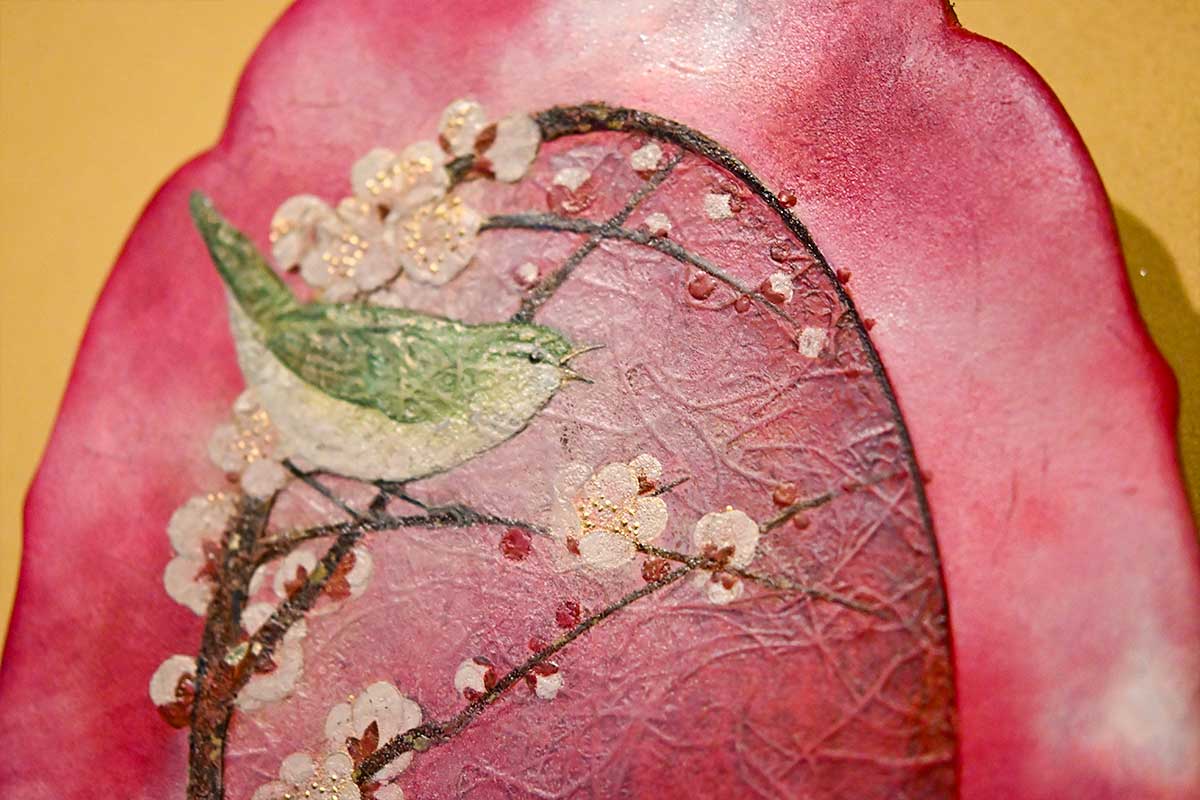
To evoke the aesthetic spirit of Kyoto, we invited lacquer artist Nagisa Nukina, who works within the tradition of Kyoto maki-e (gold lacquer decoration), to collaborate with us.
The spatial design was initially shaped by Nukina’s works and exhibition layout. However, we shared a commitment not to present lacquer art and live music side by side as separate elements, but to foster meaningful interaction between them. Through extensive dialogue, we gradually refined the concept.
The atmosphere seemed to embody the event’s title perfectly.
The term “Oumei” (嚶鳴), proposed by Nukina, refers to birds calling to one another. It resonated strongly with our concept of mutual interaction. Moreover, the visual beauty of the characters themselves made it an ideal title. The subtitle, “Resonance of Lacquer, Brilliance of Sound,” expresses our desire to move freely between lacquer and music, between the visual and the auditory.
From this concept emerged the theme of “birds and plants.” The motif of flowers and birds (kachō) has long been central to Japanese art. Through Nukina’s contemporary perspective and refined technique, traditional themes were reinterpreted with freshness and vitality. Works such as Futari Shizuka and Sayo Shigure were inspired by compositions of the same titles by Yuukai Kenchiku.
In turn, we conceived our musical program in response to these artworks. Beyond those two pieces, we selected compositions centered on the plant imagery depicted in Nukina’s works. Additionally, mindful of the venue’s traditional wooden architecture, we favored the wooden romantic flute over the modern metal flute, allowing its warmer tone to harmonize with the environment.
We understand that even the refreshments served during intermission were carefully selected.
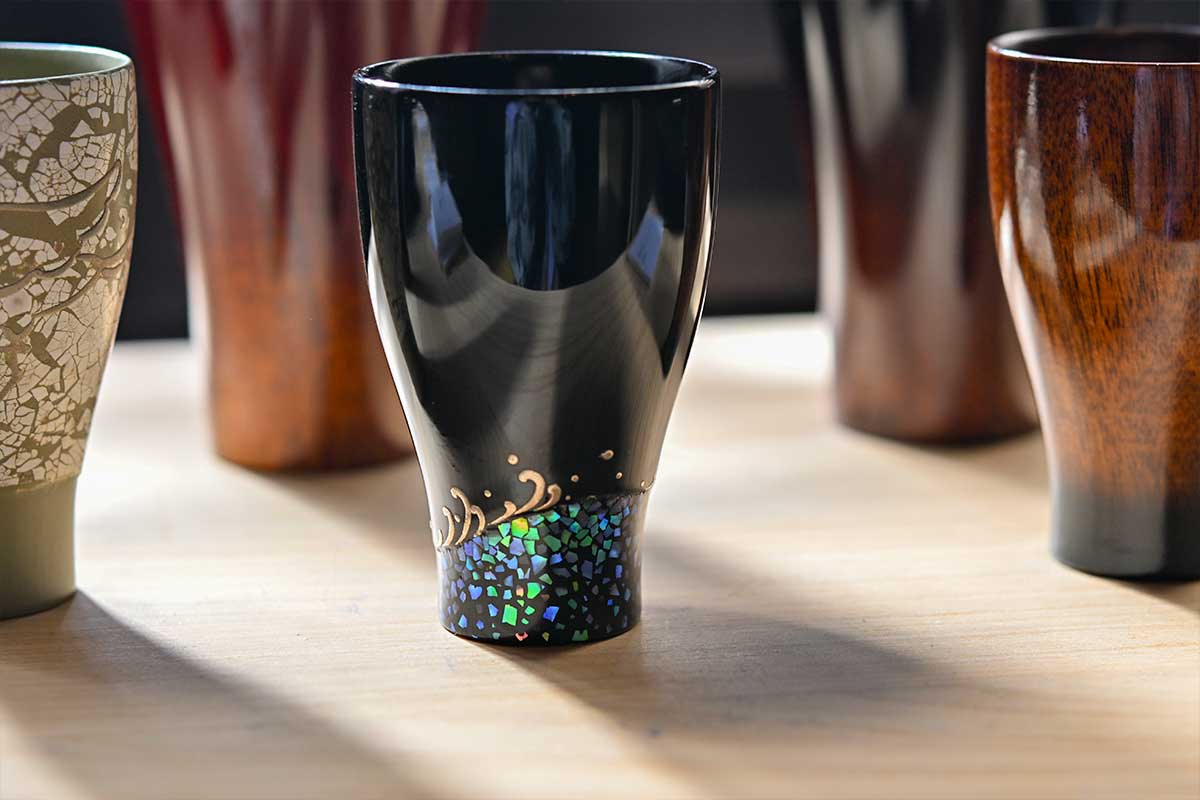
As the event took place during the New Year season, we chose ume-kombu tea in reference to the auspicious custom of daifuku-cha. Because the tea was served in lacquerware crafted by Nukina, we sought a blend befitting its elegance—free of additives and made solely from plum, kelp, and salt. We also conducted repeated tastings to select confections that paired harmoniously with the tea.
How did you first meet Ms. Nukina?
Several years ago, while planning merchandise for the band, we considered creating lacquer items inspired by our name, our professionally calligraphed logo, our musical style, and our Kyoto base. We approached Nukina to produce these items—only to discover that she was, in fact, the spouse of a friend. Serendipity plays an intriguing role in artistic collaboration.
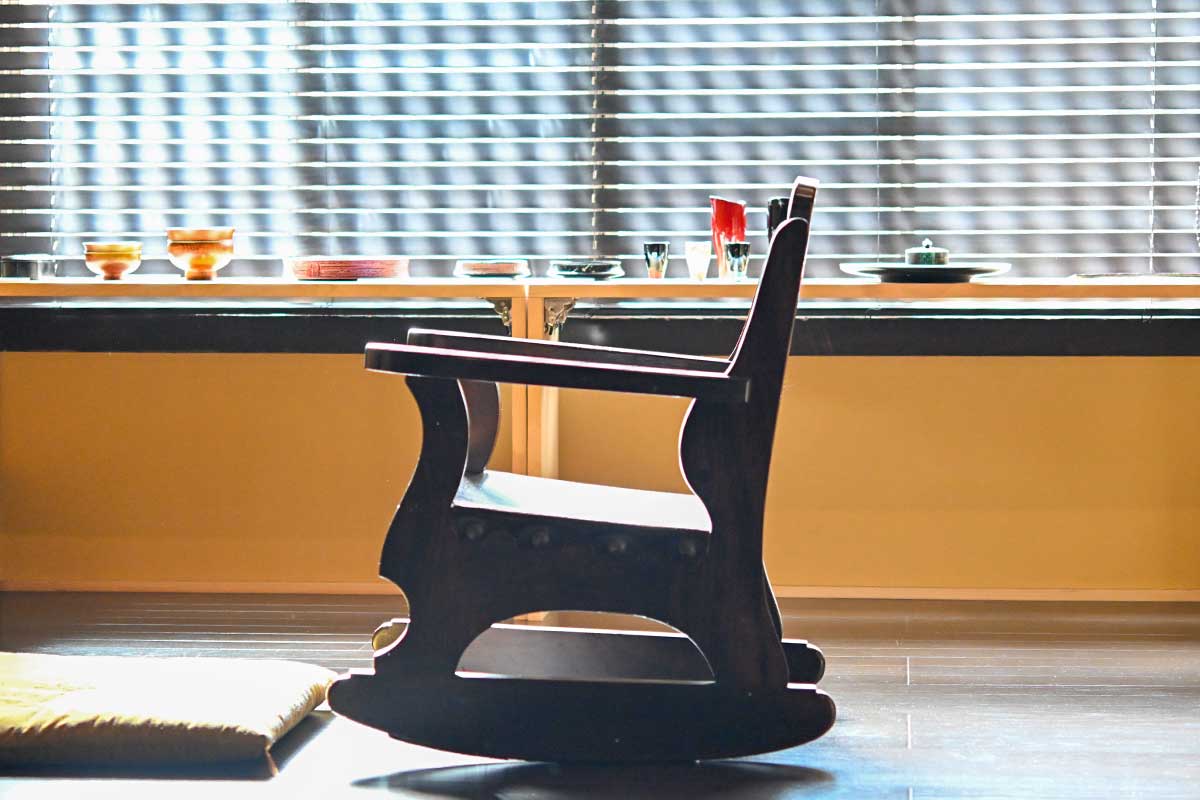
How did “Nikai” feel when adorned with her works?
It was extraordinary. Lacquer, maki-e, and raden (mother-of-pearl inlay) transform in response to light. Because “Nikai” features large south-facing windows, the quantity, angle, and color of sunlight shift throughout the day. Each viewing revealed a different expression in the works.
Moreover, the exhibition was not a simple display of individual pieces; it was organized around a cohesive concept. This narrative quality enriched the experience of the space.
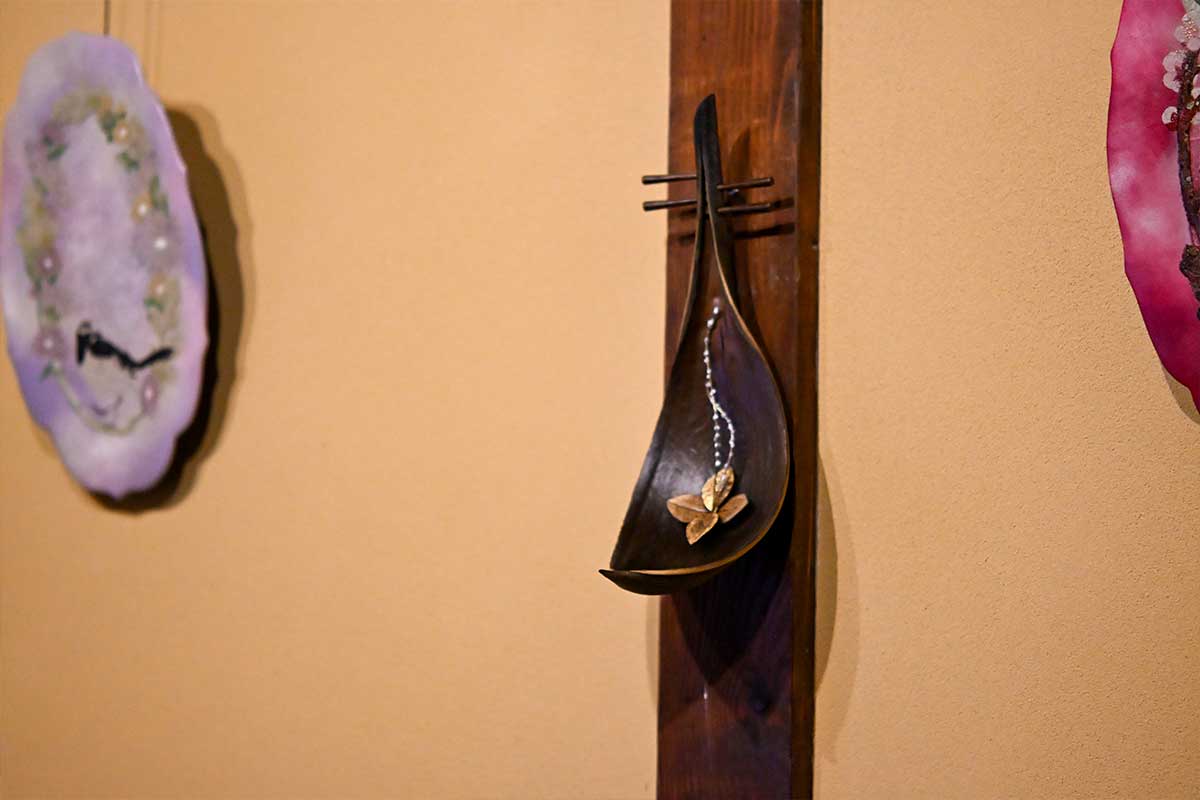
How was it to perform live in such an intimate setting?
The proximity to the audience created a concentrated and immersive atmosphere. Listeners could perceive even subtle breaths. It felt as though they were not merely hearing the music, but sensing its texture—much like holding a lacquer vessel in one’s hands.
How did the traditional machiya environment complement the performance?
The acoustics were ideally suited to a small-scale concert, producing a warm resonance. Fine nuances reached the audience clearly, enabling delicate expressions that would be difficult to achieve in a typical live house. The environment itself inspired new ideas during the performance.
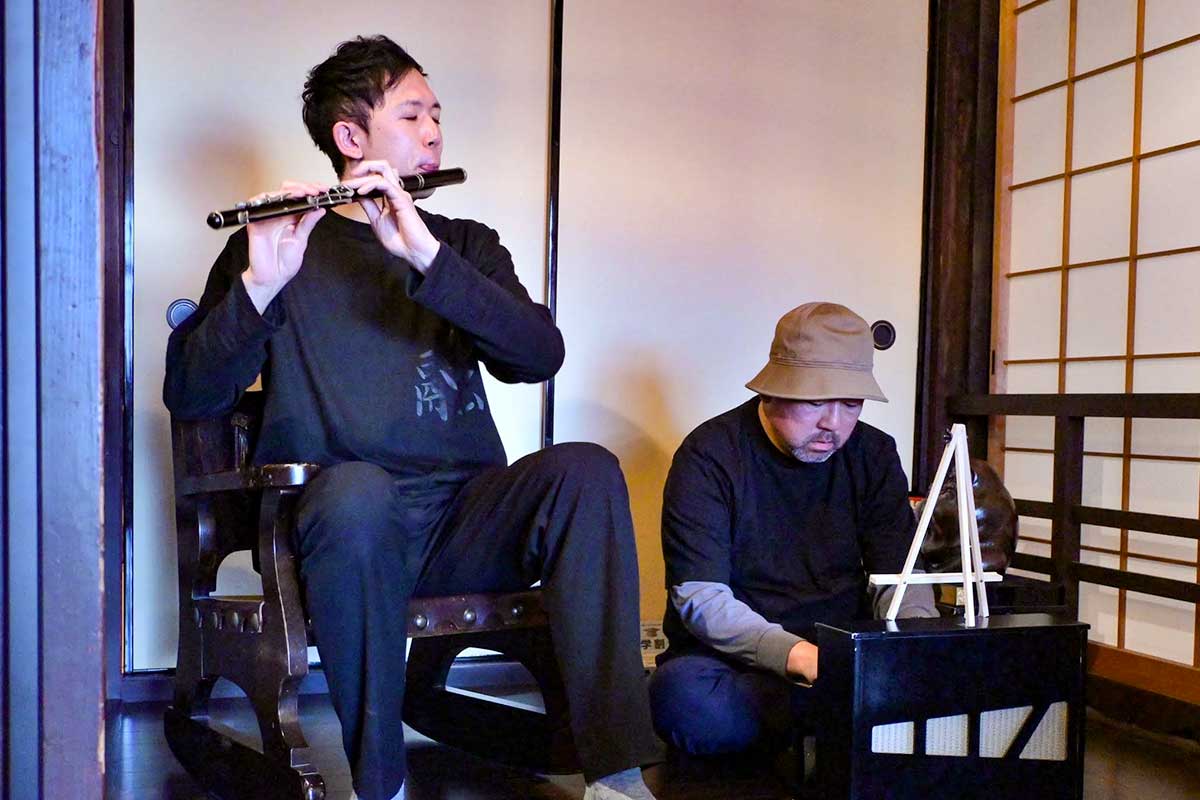
How did audiences respond?
The response was overwhelmingly positive. Some visitors came primarily to see the lacquer works and discovered an appreciation for the music; others attended for the performance and found themselves drawn to the lacquer art. This reciprocal crossover affirmed the event’s success.
What are your future plans?
While this collaboration centered on sound, we are interested in exploring projects that engage the sense of smell—perhaps incorporating incense or aromatics. If anyone feels inspired to collaborate, we would be delighted to hear from them.
* Photo Credits
- Nagisa Nukina
- Ken Ikeshima