

<Artist Statement>
Because my hometown is in the suburbs, changes occur more slowly compared to the city. Even so, over the past decade, development has progressed, the generations of long-time residents have shifted, houses have been rebuilt, and I spend my daily life quietly coming to terms with the fact that right now is a transition period in which the landscapes I knew are changing.
While there are places where the scenes I have been familiar with since childhood remain completely untouched, there are others that have changed entirely before I even realized it. Yet, those new scenes have also integrated so seamlessly into my current daily life that I can no longer recall what used to be there. Whenever I witness a landscape I knew fade away, it aches terribly. But upon reflection, most of the scenes I saw in my childhood were newly developed during the Showa period; I know nothing of the landscapes that existed in the era before that.
As long as I live here, even newly created landscapes will eventually blend into everyday life, becoming part of my memories of home and woven into a sense of nostalgia. Without records like photographs or paintings, I easily forget past landscapes as I go about my daily routine.
I accept that I am placed within a state of constant flux—something that feels as though it should always remain unchanged—and I even accept the profound loneliness that sometimes strikes when I fail to accept it. That is a form of nostalgia acquired only by continuing to live in one’s hometown. Living here and witnessing the shifting scenery day by day, I often find myself pondering recently: does a hometown exist only within memory, and what exactly is it that makes my hometown feel like home to me?
– Eri Hatta
Ahead of the Hatta Eri Solo Exhibition, Thinking of Things From Afar, which opens on October 9, 2026, at Feel Records Kyoto Hanare “Gallery Nikai,” we spoke with the artist about her background and the highlights of the exhibition.
Infusing the Accumulated Time and Breath of the People into the Land
Please introduce yourself.
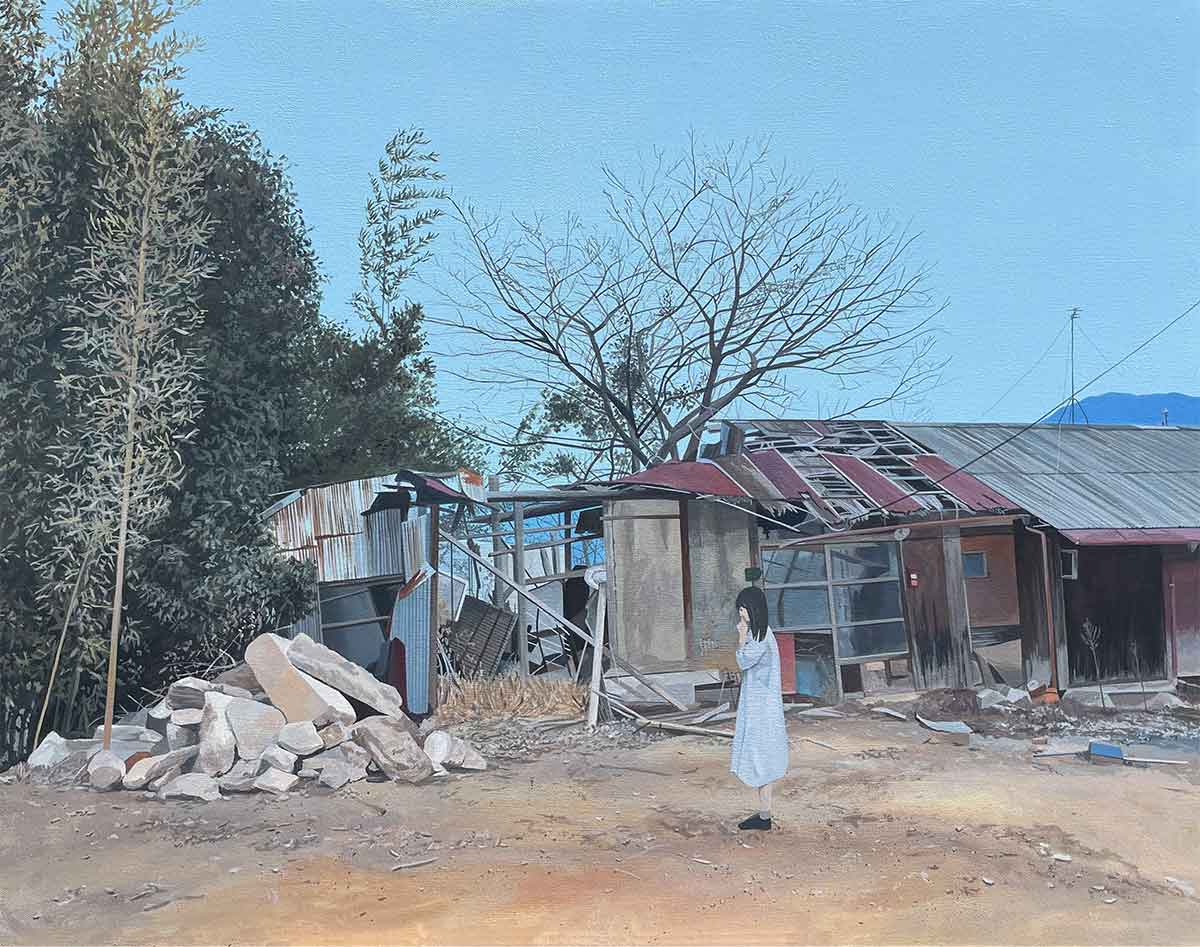
My name is Hatta Eri, and I am a painter. Using acrylic paints, I depict scenes of my hometown and landscapes I encounter while traveling—places I have actually visited in person. Rather than sketching on site, I paint by looking at photos taken on my smartphone, faithfully reproducing and capturing those images on canvas.
What originally led you to start painting?
Ever since I was an elementary school student, I admired the profession of an illustrator. I loved the idea of drawing cute characters that would appear in books or on merchandise for many people to see. Wanting to pursue a career in art, I joined the art club in middle school, specialized in art in high school, and studied in the illustration department at a vocational college. Art has been an unbroken, continuous part of my life since childhood.
Could you share any artists or works that have influenced you?
In my teens, I loved music and wanted to pursue artwork related to the music industry. I deeply admired the illustrator Nakamura Yusuke, known for creating the CD jacket artwork for ASIAN KUNG-FU GENERATION.
My introduction to contemporary art came through the artist Otsuki Kana. She had designed an album cover for KAREN, a band I loved. Visiting her solo exhibition opened my eyes to contemporary art galleries and art fairs, inspiring me to pursue my own artistic activities within the framework of contemporary art.
The work that most heavily influences my current painting style, however, is not a piece of visual art, but a book: The Forgotten Japanese by folklorist Miyamoto Tsuneichi. It vividly records the lives and daily realities of unnamed, ordinary people who were omitted from historical narratives. Learning the value of paying attention to and recording things that would otherwise be forgotten gave me a sense of purpose, driving me to reflect that same spirit in my own paintings.
What do you express through your artwork?
While I paint real landscapes seen through my own eyes, I aim to infuse the canvas with the time that has flowed and accumulated within that land, as well as the subtle presence and breath of the people who have lived there.
The young girl appearing in my paintings represents myself, while also acting as a residual memory or thought left behind by the people who have passed through that space. Because she cannot be strictly defined as the artist herself, I affectionately refer to her as “Shinen-chan”.
Nostalgia Acquired Only by Continuing to Live in One’s Hometown
What is the concept behind your solo exhibition at Gallery Nikai?
I have lived in my hometown my entire life and have never left it. I have spent all these years in the same land, developing a deep attachment to it. Precisely because of this, I feel that as I grow older, the feelings I hold toward my hometown inside me have evolved into something quite complex—something entirely different from the homesickness felt when one is living far away.
With this solo exhibition, I want to organize in my own way the nostalgia that can only be acquired by continuing to live in one’s hometown. I titled the exhibition Thinking of Things From Afar. This line is borrowed from the famous opening verse of Muroo Saisei’s poem Shokei Ijo: “One’s hometown is something to think of from afar, and to sing of with sorrow.”
While this piece is widely known as a poem singing of the complex feelings Saisei harbored toward his birthplace, contrary to its content, it is said to have been written while he was actually staying in his hometown of Kanazawa. Living in my hometown and witnessing the shifting scenery day by day, I often find myself pondering recently: does a hometown exist only within memory, and what exactly is it that makes my hometown feel like home to me?
What kinds of works will be on display at this exhibition?
I will be exhibiting works depicting the landscapes of Kameoka, my hometown. It promises to be an exhibition where various timelines coexist—landscapes that have vanished, scenes that still remain, and vistas that are continuously changing.
What does expression mean to you, Hatta-san?
Regarding the solo exhibitions I hold once or twice a year, I present my work with the intention of compiling and recording what interested me at any given time, as well as how I perceived and thought about things during those periods.
When it comes to painting itself, I enjoy creating while imagining how fascinating it would be if, say, a hundred years from now, my work ended up in someone’s hands and took on an unexpected value beyond my knowledge—serving as a precious historical record that captured the landscapes of this era.
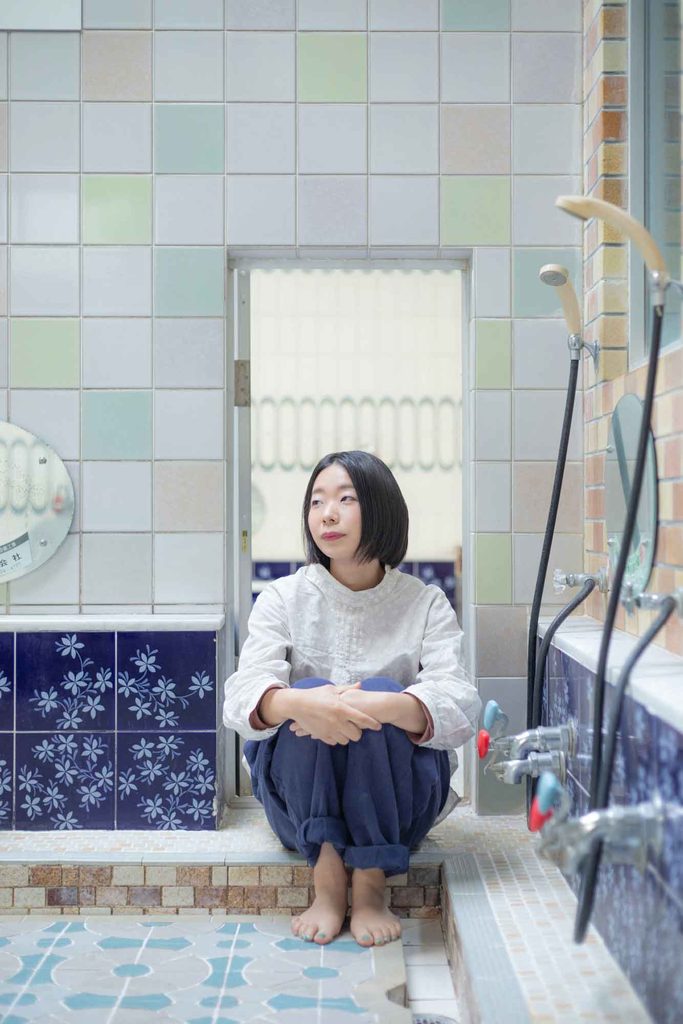
Eri Hatta
Born in 1989 in Kameoka City, Kyoto Prefecture, where she currently resides. Using acrylic paints, she depicts landscapes from her hometown and places she has visited on her travels with a meticulous yet subtly surreal touch. The figures appearing on her canvases reflect the artist herself as a bystander observing the scenery, while also serving as symbols of residual thoughts left behind by the people who have passed through those lands. From a third-person perspective, she detachedly records the subtle presence and breath of the people who have lived within these ordinary Japanese regional landscapes.
Recent Exhibitions
- 2026: Drifting Things (Sanzui / Kyoto)
- 2026: Remnants of Passing Days (Kintetsu Department Store Main Store Abeno Harukas Art Gallery / Osaka)
- 2025: The Oldest Memory (Shibatacho Gallery / Osaka)
- 2024: Hatta Eri Painting Exhibition (Kintetsu Department Store Main Store Abeno Harukas Art Gallery / Osaka)
- 2023: Memories of a Stroll / Encounter (MASATAKA CONTEMPORARY / Tokyo)
- 2023: Land Where the Wind Blows (Shibatacho Gallery / Osaka)
Hatta Eri Official Website: https://ellie.egoism.jp/
Hatta Eri Instagram: https://www.instagram.com/ellie_31773
Hatta Eri Solo Exhibition: Thinking of Things From Afar
Dates: Friday, October 9 – Saturday, October 17, 2026
Hours: 10:00 – 18:00
Closed: Tuesday, October 13 & Wednesday, October 14
Admission: Free